Fungus Gnats: The Ultimate Cure
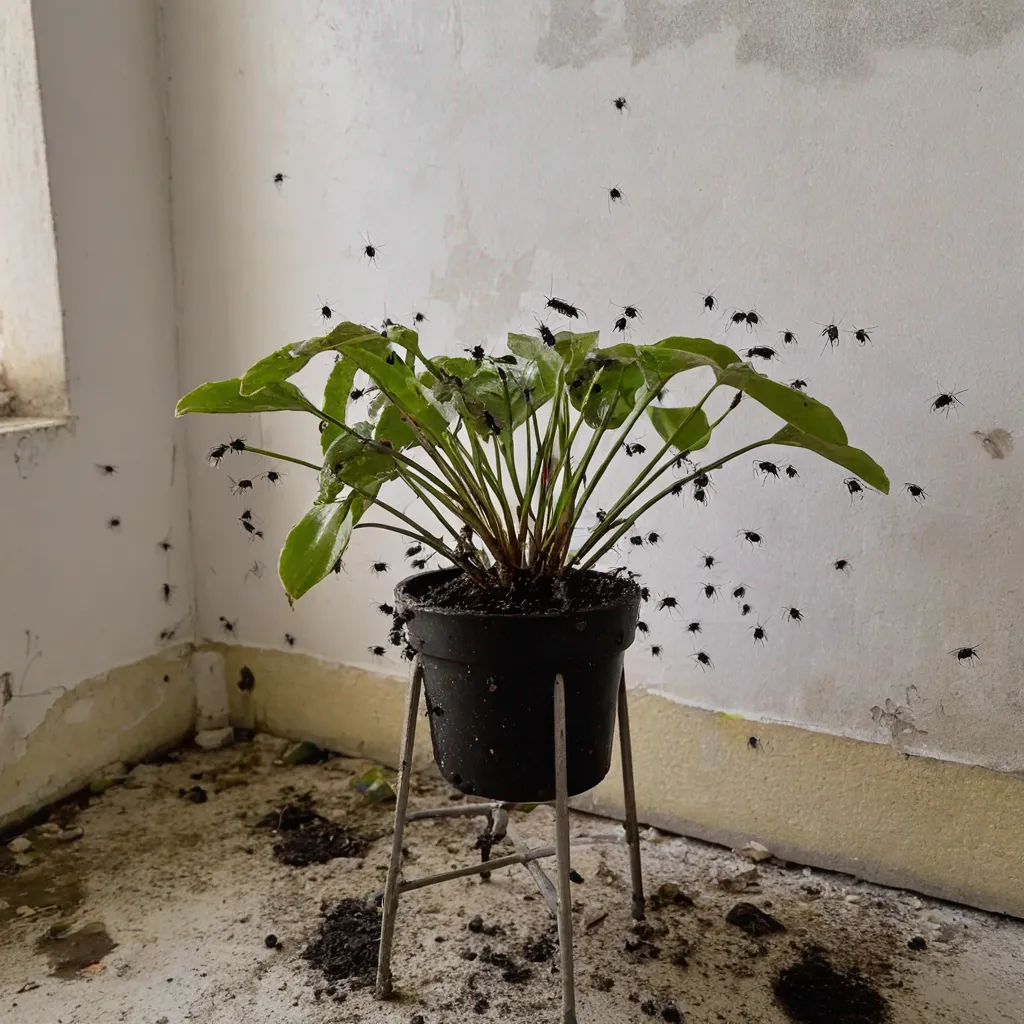
Not directly death by fungus gnat, but death by gnat-panic: letting soil dry out completely in hopes of starving them, only to discover plants can’t survive that treatment. Live and learn.
If tiny flies are hovering around your plants right now, you’ve probably tried letting soil dry (guilty) or bought random spray at the garden center that did absolutely nothing. After three separate infestations, here’s what actually works.
Here’s the thing: fungus gnats aren’t that hard to get rid of once you understand what you’re fighting. You just need the right tools and a little patience.
Using Mosquito Bits (BTI)
Section titled “Using Mosquito Bits (BTI)”This is the nuclear option, and it works.
Mosquito Bits are these little granules that contain BTI, which stands for Bacillus thuringiensis israelensis. That’s a bacteria that kills gnat larvae in the soil. It sounds scary and chemical, but it’s actually organic and won’t hurt your plants, your pets, or you. According to research from the University of California Agriculture and Natural Resources, BTI specifically targets the larvae of fungus gnats and mosquitoes without affecting other organisms.
I was skeptical at first because the package looks like something you’d use in a pond, not on a houseplant. But after my friend Sarah swore by them, I grabbed a container from the hardware store for about twelve dollars.
Here’s how you use them. Take about a tablespoon of the bits and sprinkle them on top of your soil. Then water the plant like normal. The BTI gets into the soil and when the larvae eat it, they die. Simple as that. You can also make a BTI tea if you want to be fancy about it. Soak a quarter cup of bits in a gallon of water for about thirty minutes, strain it, and use that water on your plants. I do the tea method because I feel like it distributes more evenly.
You won’t see results overnight. It takes about a week because BTI only kills the larvae, not the adult gnats flying around. Those adults will live out their short lives (more on that in a minute), but they can’t reproduce successfully because their babies keep dying in the soil. After two weeks of consistent treatment, my gnat problem was basically gone.
The main thing is you have to treat ALL your plants, not just the one with visible gnats. I made that mistake the first time. I treated my fiddle leaf fig but ignored my snake plant in the corner, and guess what? The gnats just moved over there and kept breeding. Treat everything.
Yellow Sticky Traps
Section titled “Yellow Sticky Traps”Okay, sticky traps don’t cure the problem. Let me be clear about that upfront. But they help, and more importantly, they tell you if your BTI is working.
These are just small yellow cards covered in sticky stuff. Fungus gnats are apparently very attracted to the color yellow (nobody really knows why, but studies from multiple universities confirm they are). You stick these traps in your pots or hang them nearby, and the adult gnats fly over and get stuck.
I bought a pack of twenty traps for about eight dollars online. Each trap is on a little stake, so you just push it into the soil. Within hours, I had gnats stuck to them. It was gross but also satisfying.
The traps serve two purposes. First, they catch the adult gnats that are currently flying around. This doesn’t solve the root problem because those adults have probably already laid eggs in your soil, but it does reduce the annoying factor. Second, and this is the important part, the traps let you monitor your progress. After you start using BTI, you should see fewer and fewer gnats on the traps each week. If you don’t, something’s wrong. Maybe you’re overwatering, maybe you missed a plant, or maybe you need to treat longer.
I keep sticky traps in my plants permanently now. Not because I have gnats, but because they give me an early warning if I’m overwatering or if something’s off. If I see even two or three gnats on a trap, I know I need to let things dry out a bit.
One warning: these traps are extremely sticky. I got one stuck in my hair once while repotting, and I had to cut a small section out. Not my finest moment. Keep them away from pets and kids, and be careful when you’re working around your plants.
 Above: A close up look at the symptoms.
Life Cycle of a Gnat
Section titled “Life Cycle of a Gnat”Understanding how these bugs reproduce completely changed how I deal with them.
A fungus gnat lives for about two to four weeks total, according to Penn State Extension research. But here’s the problem: each female can lay up to 300 eggs during her short life. She lays them in moist soil, usually in the top two inches. The eggs hatch in about four to six days, and the larvae live in the soil for about two weeks, eating organic matter and plant roots. Then they pupate for a few days and emerge as adult gnats, ready to start the cycle all over again.
This is why just killing the adult gnats doesn’t work. By the time you see adults flying around, there are already eggs and larvae in your soil. And this is also why the BTI takes about two weeks to show full results. You have to break the cycle by killing the larvae, then wait for the current adults to die off naturally.
When I first had gnats, I would kill every adult I saw. I’d clap them out of the air like some kind of maniac. It didn’t help at all because I wasn’t addressing the hundreds of larvae in my soil. Once I learned about the life cycle, I realized I needed to focus on the soil, not the air.
The larvae need moisture to survive. This is why fungus gnats are almost always a sign of overwatering. If your soil is constantly damp, you’re creating a perfect breeding ground. The larvae also feed on fungi and organic matter in the soil, which is more abundant in wet conditions.
I haven’t bought a moisture meter yet (my apartment is already full of plant stuff), but I’ve gotten better at judging soil moisture by weight. I pick up the pot before and after watering to feel the difference. If it still feels heavy, I wait. This simple habit has prevented more gnat problems than anything else.
Hydrogen Peroxide Soil Flush
Section titled “Hydrogen Peroxide Soil Flush”Before I discovered BTI, I tried the hydrogen peroxide method. It works, but it’s more labor intensive and you have to be careful.
The idea is that hydrogen peroxide kills the larvae and eggs in the soil while also adding oxygen. You mix regular 3% hydrogen peroxide (the kind from the drugstore) with water at a ratio of one part peroxide to four parts water. Then you drench the soil with it. The mixture fizzes and bubbles as it breaks down, and supposedly it kills the larvae on contact.
I tried this on a small pothos that was absolutely infested. I mixed up the solution, poured it slowly over the soil, and watched it foam. It looked like a science experiment. The plant seemed fine afterward, and I did notice fewer gnats.
The problem is you have to repeat this every few days to catch each new generation of larvae as they hatch. I got tired of mixing solutions and worried I might harm the beneficial microbes in my soil. Research from various university extensions confirms that while hydrogen peroxide can kill gnat larvae, it also kills beneficial organisms and can damage plant roots if you use it too strong or too often.
If you’re going to try this method, stick to the one to four ratio. Don’t think that making it stronger will work better. I’ve read stories of people burning their plant roots by using too much peroxide. Also, let your soil dry out a bit between treatments. You’re trying to kill gnats, not drown your plant.
I don’t use this method anymore now that I have BTI, but it’s an option if you need something immediately and can’t get Mosquito Bits right away. Just know it’s a short term fix and you’ll need to stay on top of it.
 Above: The tools you need to fix this.
Why Vinegar Traps Fail
Section titled “Why Vinegar Traps Fail”Everyone suggests vinegar traps for gnats. Put some apple cider vinegar in a jar, add a drop of dish soap, cover it with plastic wrap, poke holes in the top, and wait for the gnats to fly in and drown. Sounds great, right?
It doesn’t work for fungus gnats. It works for fruit flies, but fungus gnats are a different species with different behaviors.
I wasted two weeks with a jar of vinegar sitting on my counter before I researched this properly. According to entomology departments at several universities, fungus gnats are not particularly attracted to fermenting fruit or vinegar. They’re attracted to moisture, organic matter in soil, and apparently the color yellow. They’re not looking for your vinegar trap.
The confusion happens because people see small flying bugs in their kitchen and assume they’re all the same. Fruit flies and fungus gnats look similar if you’re not paying close attention. Fruit flies have red eyes and tan bodies. Fungus gnats have dark bodies and long legs. Fruit flies hang around your banana peels and compost bin. Fungus gnats hang around your plants.
I fell for this trap (pun intended) because I saw the vinegar method everywhere online. Everyone was so confident it worked, so I figured I must be doing something wrong. Turns out, those articles were either talking about fruit flies or written by people who never actually tried the method on fungus gnats.
If you try a vinegar trap and it works, you probably had fruit flies, not fungus gnats. And that’s fine, but if you have actual fungus gnats, you’re wasting your time. Save your apple cider vinegar for salad dressing and buy some BTI instead.
The other trap I see recommended is wine. Same deal. Fungus gnats don’t care about your cheap red wine. They want damp soil and decaying organic matter.
Here’s what actually works: BTI in the soil, sticky traps to catch adults, and better watering habits to prevent future infestations. That’s it. You don’t need complicated solutions or expensive sprays. You just need to target the larvae, monitor with traps, and stop overwatering.
My plants have been gnat free for about seven months now. I still use BTI preventatively every few months, especially in winter when I tend to overwater because the soil dries slower. I keep sticky traps in a few pots just to stay alert. And I’ve gotten much better at bottom watering and letting things dry out properly.
You can fix this problem. It just takes the right approach and a little patience. And maybe don’t do what I did and kill your plant while trying to kill the gnats. That would be a shame.
References
Section titled “References”University of California Agriculture and Natural Resources. “Fungus Gnats.” UC IPM Pest Management Guidelines.
Penn State Extension. “Fungus Gnats.” Department of Entomology.