The 'Death Plug'
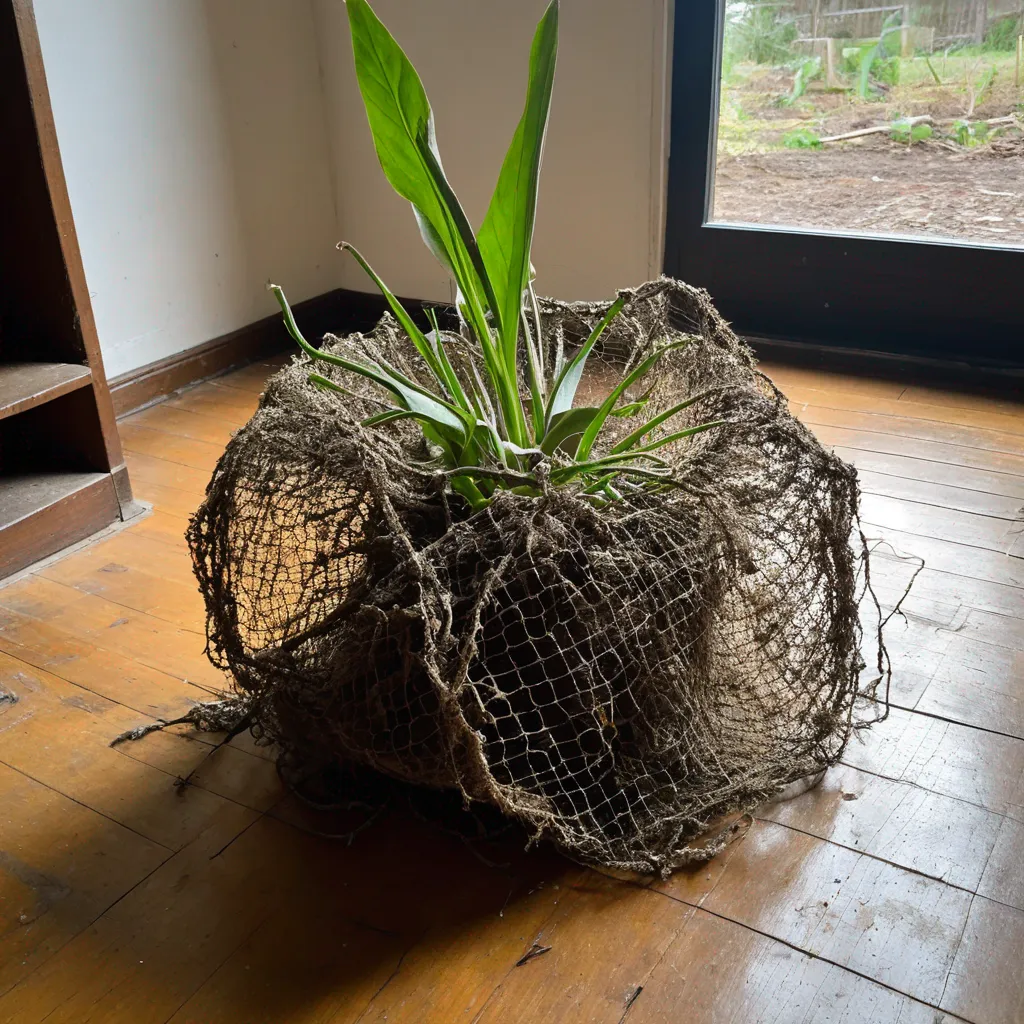
It’s a secret killer hiding in the roots of your nursery plants. You water correctly, you give it light, and yet the plant slowly rots away for no apparent reason. It’s called a “death plug”—a fabric-wrapped cylinder of soil used by growers to start seedlings. While great for nurseries, these plugs strangle roots and hold excess moisture once the plant reaches your home. I lost three perfectly good plants to this hidden menace before I learned to check the roots of every new arrival.
If you’ve ever bought a plant from a big box store or even a nice nursery, there’s a good chance it has one of these things hiding in there. I call it the “death plug” because that’s exactly what it becomes if you don’t deal with it. Let me walk you through what to look for and how to handle it without destroying your plant in the process.
Identifying mesh plugs
Section titled “Identifying mesh plugs”The first time I discovered a mesh plug, I’d just lost a pothos that I’d owned for maybe two months. I was so frustrated that I pulled the whole root ball apart to see what went wrong, and there it was. Right in the center of the roots, a small cylinder of compressed coconut coir wrapped in this fine black mesh fabric. It was completely waterlogged and slimy, and the roots inside were brown mush.
These plugs are usually about the size of a shot glass, maybe a bit smaller. The mesh itself looks like a very fine fabric, almost like the material you’d see in a cheap reusable grocery bag. It’s typically black or dark brown, which makes it blend right in with the soil. The plug sits right where the original cutting was rooted, so it’s dead center in the root ball.
Here’s how to check if your plant has one without tearing it apart. Gently tip the plant on its side and slide it out of the nursery pot (this works best when the soil is slightly dry, not soaking wet). Look at the bottom of the root ball. If you see roots circling around the outside but the very center looks different, almost like there’s a separate plug of material that doesn’t match the rest of the soil, you probably found one.
Sometimes you can spot the mesh itself poking through. Other times, you’ll just notice that the center section feels different when you touch it. It might be denser or spongier than the surrounding soil. I’ve also noticed that plants with these plugs often have roots that grow around the plug rather than through it, which creates this weird hollow cylinder effect.
Not every plant has them. I’ve found them most often in pothos, philodendrons, monsteras, and snake plants. Basically, plants that are easy to propagate and grow fast. According to research from the University of Florida’s Environmental Horticulture Department, these plugs are standard in commercial propagation because they create uniform conditions for rooting cuttings.
Removing them safely
Section titled “Removing them safely”Okay, so you found the plug. Now what? I’m not going to lie, the first time I tried to remove one, I panicked halfway through and probably damaged more roots than necessary. But I’ve done this enough times now that I have a system.
First, water your plant a day or two before you plan to remove the plug. You want the soil moist but not soggy. This makes the roots more flexible and less likely to snap when you’re working with them.
Take the plant out of its pot and gently shake off the loose soil from the outside of the root ball. Don’t go crazy here. Just enough so you can see what you’re working with. Set the plant down on some newspaper or do this outside if the weather’s nice.
Now, locate the plug. Use your fingers to carefully work the soil away from around it. I usually start at the top where the stem meets the soil and work my way down. The goal is to expose the mesh without ripping through a bunch of healthy roots.
Once you can see the mesh clearly, here’s the tricky part. The roots have often grown through the mesh, so you can’t just yank it out. I use small scissors (the kind you’d use for detail work or even nail scissors) to carefully cut the mesh away bit by bit. Cut small sections, peel them back, and snip any mesh that’s tangled in the roots.
Some people soak the root ball in water to make this easier, and honestly, that does help loosen things up. If you go this route, fill a bucket with room temperature water and let the roots soak for about ten minutes. The mesh will soften slightly, and you can sometimes peel it away more easily.
The coconut coir inside the mesh can stay if the roots are really tangled in it, or you can gently tease it apart if it comes away easily. I’ve done it both ways. If the coir looks healthy and the roots seem fine, I just leave it. If it’s slimy or smells funky, I try to remove as much as possible without being destructive.
This whole process might take you twenty minutes. Maybe longer if you’re doing it for the first time and being extra careful. That’s fine. There’s no rush.
 Above: A close up look at the problem.
Why nurseries use them
Section titled “Why nurseries use them”I used to think nurseries were trying to sabotage us on purpose, but that’s not really fair. These mesh plugs actually serve a legitimate purpose in commercial growing operations.
When nurseries propagate hundreds or thousands of cuttings at once, they need a system that’s consistent and efficient. These plugs create a standardized growing medium that holds the right amount of moisture for rooting. According to information from the University of Georgia’s Extension Service, the mesh keeps the growing medium contained and makes it easier to handle young plants during transplanting.
The plugs also speed up production time. Instead of waiting for a cutting to root in loose soil, the plug keeps everything compact and controlled. Once the cutting has established roots, the whole plug gets dropped into a larger pot with more soil around it. Fast, easy, and scalable.
The problem is that these plugs are designed for short-term use in a controlled environment. They’re not meant to stay with the plant forever. In a commercial greenhouse with proper drainage, regular watering schedules, and climate control, the plug doesn’t cause issues. But in my apartment where I sometimes forget to water for a week and then overcompensate by drenching everything, that plug becomes a problem.
The mesh doesn’t break down quickly. I’ve found plugs in plants I’ve owned for over a year, and the mesh looked exactly the same as it probably did when the cutting was first propagated. Meanwhile, roots either can’t penetrate it properly or they grow around it, which limits the plant’s ability to establish a healthy root system.
It’s not malicious. It’s just a mismatch between commercial growing practices and home growing conditions. The nursery did their job. Now we have to do ours.
Repotting strategies
Section titled “Repotting strategies”Once you’ve removed the plug (or decided to leave it if the plant seems healthy), you need to think about repotting. I don’t always repot immediately after removing a plug, and you don’t have to either.
If the plant looks healthy, the roots are white or light tan, and there’s no rotting, you can put it back in the same pot with the same soil. Just nestle it back in and water it lightly. Keep an eye on it for the next week or so to make sure it’s not stressed.
But if you’ve removed a plug and discovered some root rot, or if the plant was already struggling, repotting into fresh soil is probably your best move. I use a well-draining potting mix. For most of my tropical plants, I mix regular potting soil with about thirty percent perlite or orchid bark. This creates air pockets and prevents water from sitting around the roots.
Choose a pot that’s only slightly larger than the root ball. I know it’s tempting to go big and give the plant “room to grow,” but that usually backfires. A pot that’s too large holds too much moisture, and you end up with the same waterlogging problem you were trying to avoid. One to two inches larger in diameter is plenty.
Make sure your pot has drainage holes. I cannot stress this enough. I’ve tried to make drainage-free pots work, and it never ends well. Water needs somewhere to go.
When you’re placing the plant in its new pot, position it at the same depth it was growing before. Don’t bury the stem deeper, and don’t leave roots exposed at the surface. Fill in around the root ball with your soil mix, and gently press it down to eliminate air pockets. Water thoroughly until water runs out the drainage holes, then let it drain completely.
I usually wait about a week before returning to my normal watering schedule. The plant needs a little time to recover from the disturbance, and the fresh soil holds moisture better than old, compacted soil.
 Above: The tools you need to fix this.
Checking root health
Section titled “Checking root health”This is the part that took me the longest to get comfortable with. I used to be terrified of looking at roots because I thought I’d damage them just by checking. But learning to assess root health has saved me so much trouble.
Healthy roots are firm and white, cream, or light tan. When you touch them, they should feel solid, kind of like al dente pasta. If you grow plants in leca or semi-hydro setups, you might see thicker water roots that are slightly darker, and that’s normal too.
Unhealthy roots are brown, black, or gray. They feel mushy or slimy, and they might smell bad. Like, really bad. Rotting roots have this distinctive sour, swampy smell that you’ll recognize immediately once you’ve encountered it. If you gently tug on a rotten root, the outer layer might slide off, leaving just a thin string behind.
When I’m checking a plant that had a mesh plug, I specifically look at the roots that were in contact with the plug. Those are the most likely to have problems. If I find rot, I use clean scissors or pruning shears to cut away the affected roots. I cut back to healthy tissue, where the root is firm and light-colored.
Some people rinse the roots under running water to get a better look, and that’s fine. I do this sometimes, especially if there’s a lot of soil clinging to everything. Just be gentle. Roots are tougher than they look, but they’re not indestructible.
After removing rotten roots, I let the plant sit out for about twenty minutes before repotting. This gives any cut surfaces a chance to dry slightly, which some resources suggest may reduce the risk of further rot. I learned this from a detailed guide on root rot management published by the Cornell Cooperative Extension.
If you find that more than half the roots are rotted, your plant is in serious trouble. You can still try to save it, but it’s going to be a long recovery. Trim away all the rot, repot in fresh, well-draining soil, and keep the soil on the drier side while new roots develop. Some plants bounce back. Some don’t. I’ve had it go both ways.
One thing I check for now, every single time I bring a new plant home, is whether there’s a mesh plug hiding in there. It takes two minutes to slide the plant out of its pot and look. If I find one and the plant seems healthy, I’ll often leave it alone until the plant needs repotting anyway. But at least I know it’s there, and I can adjust my watering to account for it.
I wish someone had told me about these plugs when I first started keeping plants. It would have saved me a lot of confusion and a few dead pothos. But now I know, and now you know, and hopefully, your plants will be better off for it.
References
Section titled “References”University of Florida Environmental Horticulture Department. Commercial Foliage Plant Propagation Methods and Standards.
University of Georgia Extension Service. Propagation of Ornamental Plants: Systems and Techniques.
Cornell Cooperative Extension. Root Rot Prevention and Management in Container Plants.